What Is a Tokamak?
This will be my first entry in this blog. I feel it necessary to cover this subject first because the answer to the titular question is far simpler than most articles, Wikipedia pages, and academic writings make it out to be. In my humble opinion, it is probably the most elegant of the “classic” solutions to the problem of fusion.
I hope you find this explanation enlightening.
The Problem of Fusion
To start, I’m going to briefly touch on the problem of fusion. I will assume that, if you’re reading this, you are already aware of the promise of fusion: incredible energy from abundant, clean fuel. However, unlike fission, where the challenge is essentially making sure the reaction doesn’t run away from you (Chernobyl being the canonical example), the challenge of fusion is making it happen at all.
To cause two atoms to fuse, their nuclei must “touch.” That’s it. The trouble is that, without exception, atomic nuclei are positively charged. Like charges repel one another, and as a result, atomic nuclei do not want to touch. This phenomenon is what is referred to as the Coulomb barrier.
Thankfully, this is not an insurmountable barrier. A nucleus has a barrier “height” which is directly related to its positive charge. This height, combined with other factors, determines how much energy is required to fuse different fuel combinations. For D-T (deuterium-tritium, the most promising fuel combination for a tokamak), the barrier is roughly 400 keV of relative kinetic energy. In a future post I will explain why, but for now, take my word for it: that’s a lot of energy. Fortunately, quantum tunneling lets nuclei fuse well below the top of the barrier, and in practice we never come close to investing 400 keV per reaction. This is where the physics of the tokamak come in.
What Is a Tokamak?
If you’ve ever looked up a picture of a tokamak, you’ve probably ended up staring at either an industrial setup of almost impossible complexity or a simple diagram roughly resembling a doughnut. Neither perspective gives the reader much useful information beyond the complex reality of solving what is a pretty straightforward problem. So here I will, in plain English, explain the function of the tokamak before delving into why and how it solves the problem of nuclear fusion.
A tokamak is, in simplest terms, a magnetic nuclear furnace. Except instead of burning fossil fuels, we want to burn simpler, cleaner, and even more abundant fuel. Its sole reason for existing is to provide an environment in which a fantastically hot plasma can be heated, confined for long enough to matter, and (ideally) tapped for the energy released once it ignites. To this end, the engineering of a tokamak can be distilled down to two challenges: confinement and heating.
The Challenges
Confinement
Starting with confinement, we need a way to keep the plasma away from the walls of the reactor. This is not only because contact would quench the plasma (dramatically reduce its temperature), but also because it could irreparably damage the walls. Fortunately, the charged particles that make up a hot plasma are highly responsive to magnetic fields: they gyrate along the field lines, moving along a line while simultaneously making tiny orbits around it.
One instinct would be to make a magnetic bottle in a straight line. But a straight bottle leaks out the ends. A doughnut, though? There are no ends. The particles can follow the field lines forever. Combine this with a strong magnetic field (the stronger the better; more on that later) and we have the foundation of a containment vessel for our insanely hot plasma.
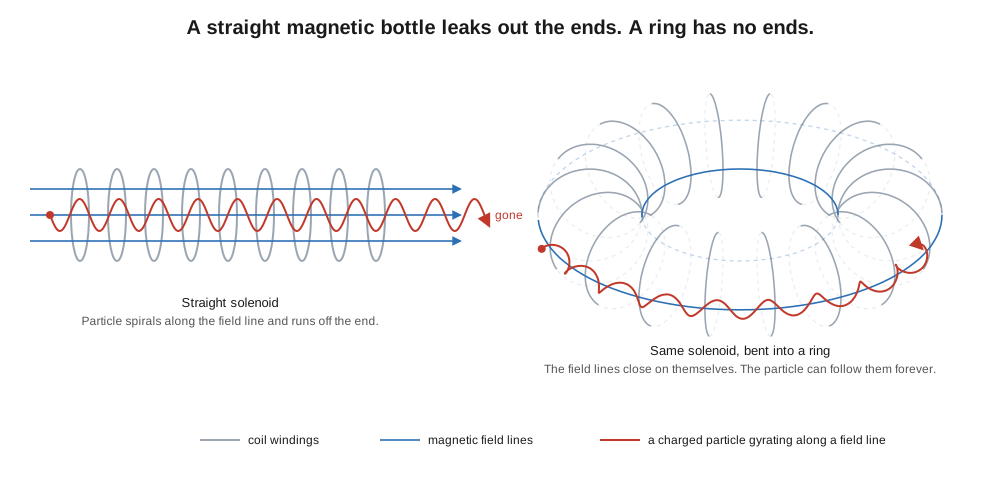
Why a ring. A charged particle follows a magnetic field line, spiraling tightly around it as it goes. In a straight coil the field lines exit at the ends, and the particle exits with them. Bend the same coil into a ring and every field line closes on itself, so there is nowhere for the particle to leave.
Heating
Once we have our vessel, we need to heat the plasma. This process begins with a component that is almost never prominently featured in diagrams or descriptions of a tokamak: the central solenoid. Put simply, this is a coil of conductive material standing in the hole of the doughnut, and it turns what is a simple magnetic doughnut into one big transformer.
Here’s the idea. A plasma has its own resistivity, and you can drive a current through it. As happens when you drive a current through any conductive material, the material heats up. That’s what we want. But how do you drive a current through something you can’t touch? The same way a transformer does: the plasma ring encircles the solenoid, so a changing current in the solenoid induces a current around the plasma, with no wires touching it. In the context of a tokamak this is referred to as resistive or ohmic heating.
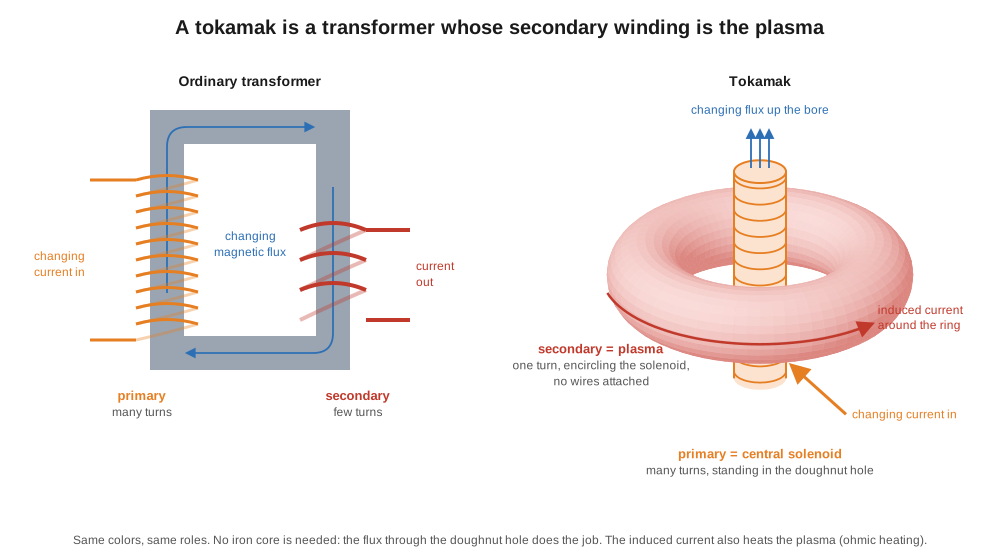
The transformer. On the left, an ordinary transformer: a changing current in the primary drives a changing magnetic flux through the core, which induces a current in the secondary. On the right, the tokamak: the central solenoid standing in the doughnut hole is the primary, the flux runs up through the hole, and the plasma ring around it is the secondary, a single turn with no wires attached. Same physics, with the iron core replaced by the hole in the doughnut.
In practice, of course, things aren’t that simple. For one thing, as the plasma temperature increases, its resistivity drops, meaning there is an upper limit to how much we can heat the plasma using its own resistance. In addition, ohmic heating requires some pretty serious current to start with (more on that later). Further heating past this initial stage usually comes from RF heating and neutral beam injection. These will be discussed later, since they are not as relevant to the design that is the subject of this blog.
In Closing
Aficionados will point out that I’m leaving things out of the description above: how the plasma column is kept from kinking, how a device’s dimensions determine its ultimate capabilities (why ITER is the size of a building), and how the toroidal field and the plasma’s own magnetic field work together to assist in confinement. But these facets of the concept deserve their own dedicated descriptions and walkthroughs. For now, I believe the above will serve any reader as a solid primer for what will come in later entries. For those of you who are still curious to learn more and see what it is I’m working on, read on!